In mechanical engineering, small clearances between components are necessary for assembly, thermal expansion, and lubrication. However, these same clearances can introduce unwanted movement that affects performance, precision, and reliability. Three specific types of clearance-related issues—backlash, endshake, and side-shake—often go unnoticed during design but can significantly impact mechanical systems.
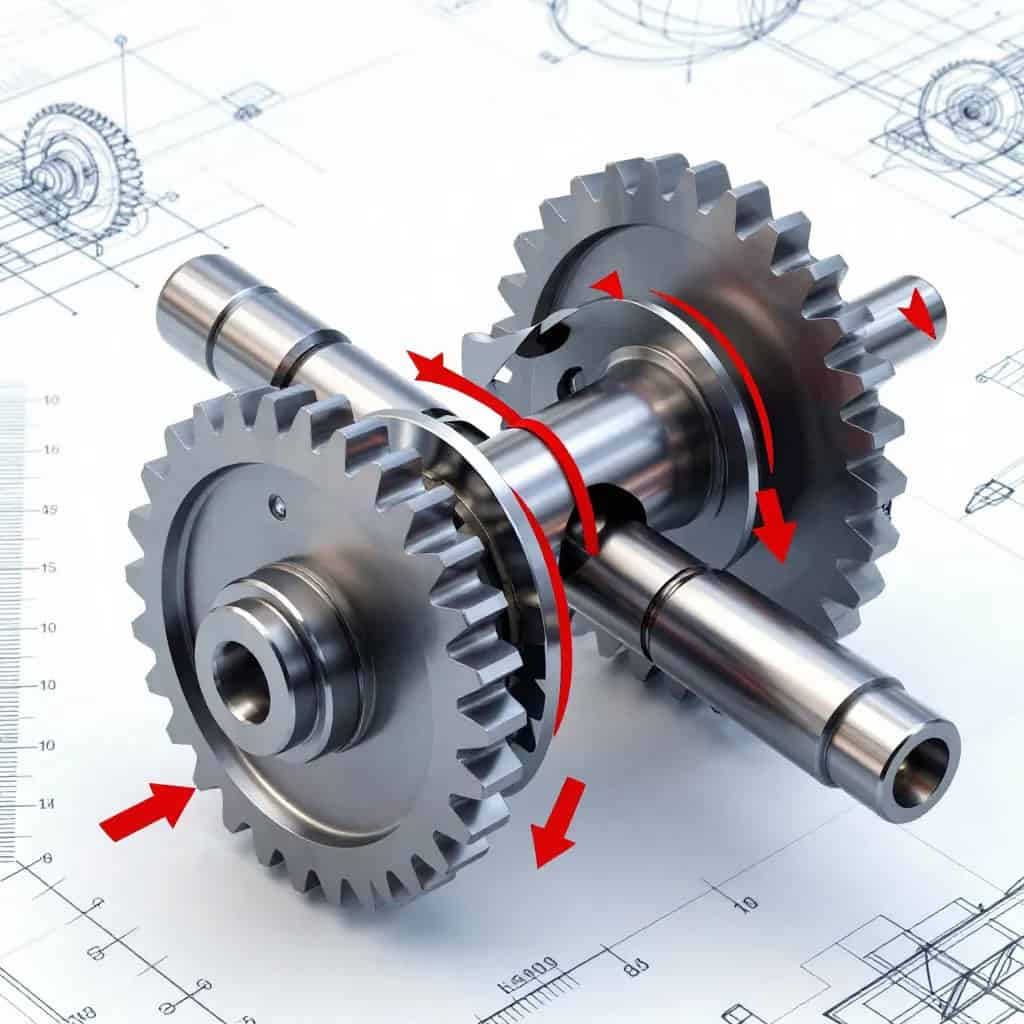
Backlash: The Play in Power Transmission
Backlash refers to the clearance or slack between mating gear teeth, screw threads, or other mechanical interfaces. In gear systems, backlash creates a dead zone where input movement occurs before output movement begins. This gap results from the space between the active faces of mating teeth.
The effects of backlash extend beyond simple positioning errors. In servo systems, backlash introduces non-linearity into the control response, causing oscillations and reduced accuracy. CNC machines experience dimensional errors when direction reverses, as the system must first take up the clearance before engaging the workpiece.
Industrial applications demonstrate different tolerance requirements. A printing press may maintain 0.001 inches of backlash to ensure smooth operation, while a telescope's gear system might require 0.0001 inches to maintain precise positioning. Reducing backlash often involves spring-loaded mechanisms, dual-helix gears, or preloaded bearings.
Endshake: The Axial Dance
Endshake describes unwanted axial movement between components constrained along their rotational axis. This clearance exists at the ends of shafts, spindles, and other rotating elements where bearings or thrust surfaces allow slight axial play.
In high-speed applications, endshake creates dynamic imbalance. Rotating systems experience vibration when the center of mass shifts during axial movement. Precision lathe spindles with excessive endshake produce poor surface finishes and reduced tool life.
Temperature changes exacerbate endshake issues. As components heat during operation, thermal expansion reduces clearance, potentially causing binding. Conversely, cooling creates more play, affecting positioning accuracy. Designers use temperature-compensating features like differential expansion rates or variable clearance bearings to address this challenge.
Side-Shake: The Lateral Wobble
Side-shake refers to unwanted radial movement or play perpendicular to the intended axis of motion. This clearance exists in linear guides, bearing systems, and other precision mechanisms where radial constraint is essential.
The impact of side-shake multiplies with distance from the point of constraint. In a cantilevered tool holder, even small radial clearances at the bearing interface create significant displacement at the cutting edge. CNC gantry machines experience dimensional inaccuracies when side-shake allows the beam to shift during rapid movements.
Optical systems demonstrate extreme sensitivity to side-shake. Microscopes and telescopes require sub-micron radial precision to maintain focus and alignment. Camera lens mounts use specialized bearing designs to eliminate lateral movement, ensuring image stability across the entire frame.
Detection and Measurement
Identifying these geometric issues requires specialized techniques. Dial indicators measure backlash by rotating input shafts while recording output movement. Laser interferometry detects minute side-shake in precision systems by measuring position changes during directional reversals.
Vibration analysis reveals endshake in rotating equipment through characteristic frequency signatures. Accelerometers mounted on shaft ends detect the axial movement patterns associated with excessive clearance.
Advanced metrology systems use multi-axis sensors to simultaneously measure all three types of clearance. These systems create comprehensive clearance maps that identify problem areas in complex mechanical assemblies.
Mitigation Strategies
Reducing backlash often involves preloading mechanisms. Split bearings with adjustable shims allow precise clearance control. Dual-nut ball screws use opposing forces to eliminate thread play.
Endshake mitigation focuses on thrust bearing design. Angular contact bearings can be mounted in pairs with controlled preload to eliminate axial play. Spring-loaded thrust washers maintain constant contact regardless of thermal expansion.
Side-shake reduction employs constraint engineering. Linear motion systems use multiple bearing points to distribute radial loads. Preloaded linear guides eliminate clearance through internal force mechanisms.
Conclusion
Backlash, endshake, and side-shake represent fundamental geometric challenges in mechanical design. These clearance-related issues affect precision, efficiency, and reliability across countless applications. Understanding their causes and effects enables engineers to develop targeted solutions that improve performance.
Modern manufacturing techniques continue to push the boundaries of precision. As requirements become more stringent, the management of geometric clearances remains critical to achieving desired performance characteristics. The pursuit of backlash-free, endshake-resistant, side-shake-eliminated systems continues to drive innovation in mechanical design.