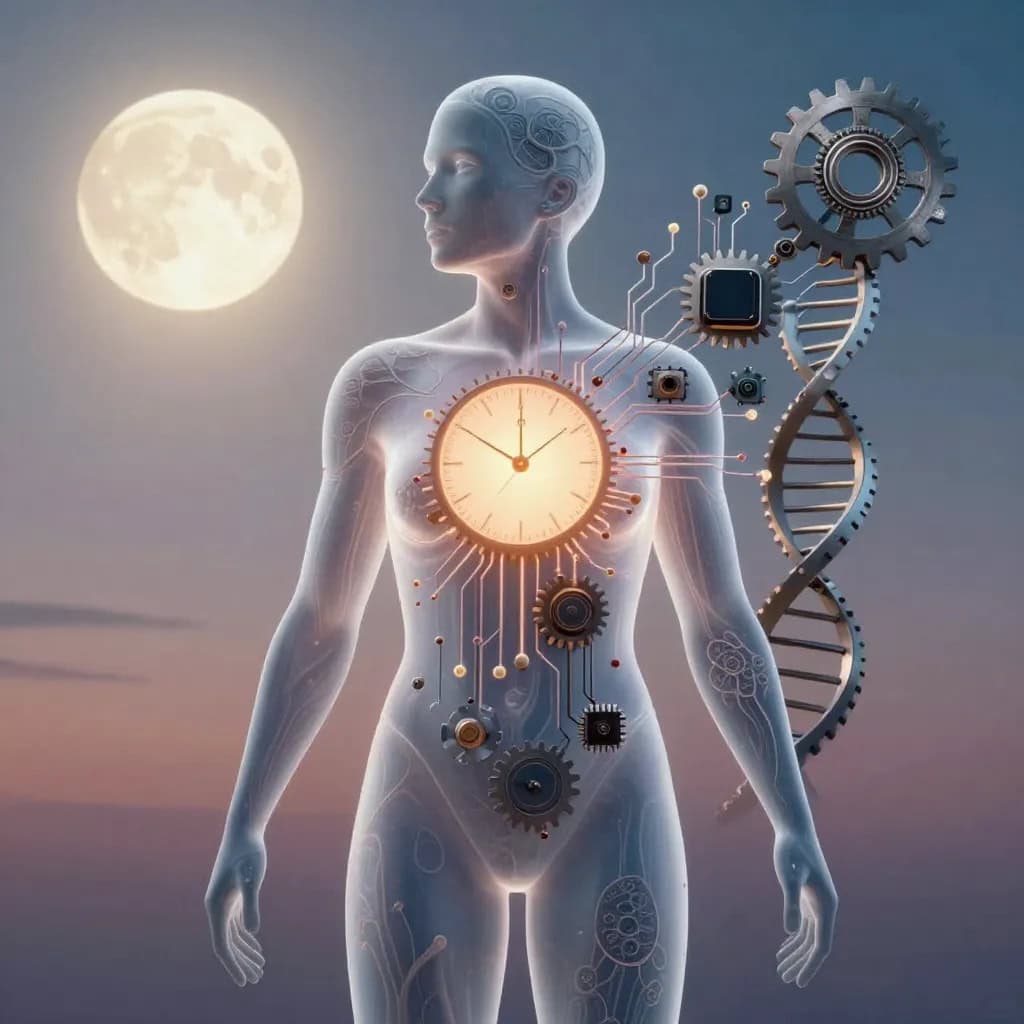
Living organisms evolved sophisticated timekeeping mechanisms long before humans invented mechanical clocks. These biological clocks, known as circadian rhythms, regulate daily processes from hormone secretion to sleep patterns. Scientists and engineers increasingly study these natural systems to develop more efficient technologies. This exploration examines how biological clocks have inspired technical designs across various fields.
Understanding Biological Clocks
Circadian rhythms operate in nearly all living things, from bacteria to plants to animals. These internal timekeepers follow approximately 24-hour cycles synchronized with environmental cues. The molecular basis varies across species but commonly involves transcription-translation feedback loops. In mammals, the suprachiasmatic nucleus in the hypothalamus serves as the master clock, coordinating peripheral clocks throughout the body.
Biological clocks exhibit remarkable precision while maintaining flexibility. They can maintain accurate timing even without external signals yet adjust to environmental changes when necessary. This combination of stability and adaptability presents an engineering challenge that has inspired technical solutions.
Early Technical Inspirations
The first mechanical clocks drew inspiration from natural timekeeping. Ancient water clocks and sundials directly mimicked celestial movements. Later, pendulum clocks incorporated principles similar to biological oscillators. The 18th-century marine chronometer, developed by John Harrison, solved the problem of determining longitude at sea by creating a timepiece stable enough for navigation.
In the 20th century, engineers began explicitly studying biological systems. The 1922 invention of the van der Pol oscillator modeled limit cycle behavior observed in biological systems. This mathematical approach captured the self-sustained oscillations characteristic of circadian rhythms, providing a framework for understanding rhythmic processes.
Modern Engineering Applications
Contemporary technology increasingly incorporates principles derived from biological clocks. Robotics researchers have developed adaptive control systems that mimic the entrainment capabilities of circadian rhythms. These systems can maintain stable operation while adjusting to changing environments, improving efficiency in autonomous vehicles and industrial robots.
In computing, energy management systems now utilize algorithms inspired by biological timekeeping. These systems schedule resource-intensive tasks during periods of optimal energy availability, mimicking the way organisms coordinate metabolic processes with environmental cycles. Google's data centers reportedly implemented such strategies, reducing energy consumption by up to 40 percent.
Materials science has also benefited from biological clock research. Self-healing polymers that respond to time-dependent environmental changes draw inspiration from the repair mechanisms found in biological systems. These materials undergo predictable degradation and regeneration cycles, extending product lifespans while reducing waste.
Challenges and Limitations
Replicating biological precision presents significant technical challenges. Biological clocks operate with minimal energy consumption, a difficult standard for mechanical systems. Electronics require substantially more power to maintain similar levels of accuracy, limiting applications in energy-constrained environments.
The adaptability of biological clocks also proves difficult to reproduce. Technical systems typically require recalibration when environmental conditions change, whereas biological clocks continuously adjust without external intervention. This self-regulating capability remains an elusive goal for engineers.
Future Directions
Emerging research focuses on synthetic biology approaches to create artificial biological clocks. These engineered organisms could serve as living sensors or produce specific compounds at scheduled times, offering new possibilities for biomanufacturing and environmental monitoring.
Neuromorphic computing, which mimics neural networks, incorporates principles from circadian research to develop more efficient processing architectures. IBM's TrueNorth chip represents an early example, using event-based processing inspired by biological timekeeping to reduce power consumption.
The cross-disciplinary nature of this research continues to grow. Biologists, engineers, and computer scientists collaborate increasingly, recognizing that biological systems offer solutions to complex technical problems. This convergence suggests continued innovation in the coming decades.
Conclusion
Biological clocks have inspired technological innovation throughout human history. From early timepieces to modern computing systems, nature's timekeeping mechanisms provide valuable models for engineering solutions. The precision, efficiency, and adaptability of circadian rhythms present technical challenges that drive innovation across multiple disciplines.
As research continues, the boundaries between biological and technical systems increasingly blur. Engineers increasingly look to nature not just for inspiration, but as a source of solutions to problems that have resisted purely mechanical approaches. This biomimetic approach likely will yield further breakthroughs in timekeeping technology and beyond.