Timekeeping forms the backbone of modern civilization. From coordinating global financial transactions to synchronizing satellite communications, precise timekeeping enables the seamless operation of our interconnected world. Several organizations maintain the standards and protocols that ensure time accuracy across different technologies and regions. This article explores three key civil timekeeping standards bodies: the International Telecommunication Union (ITU), the International Organization for Standardization (ISO), and the National Institute of Standards and Technology (NIST).
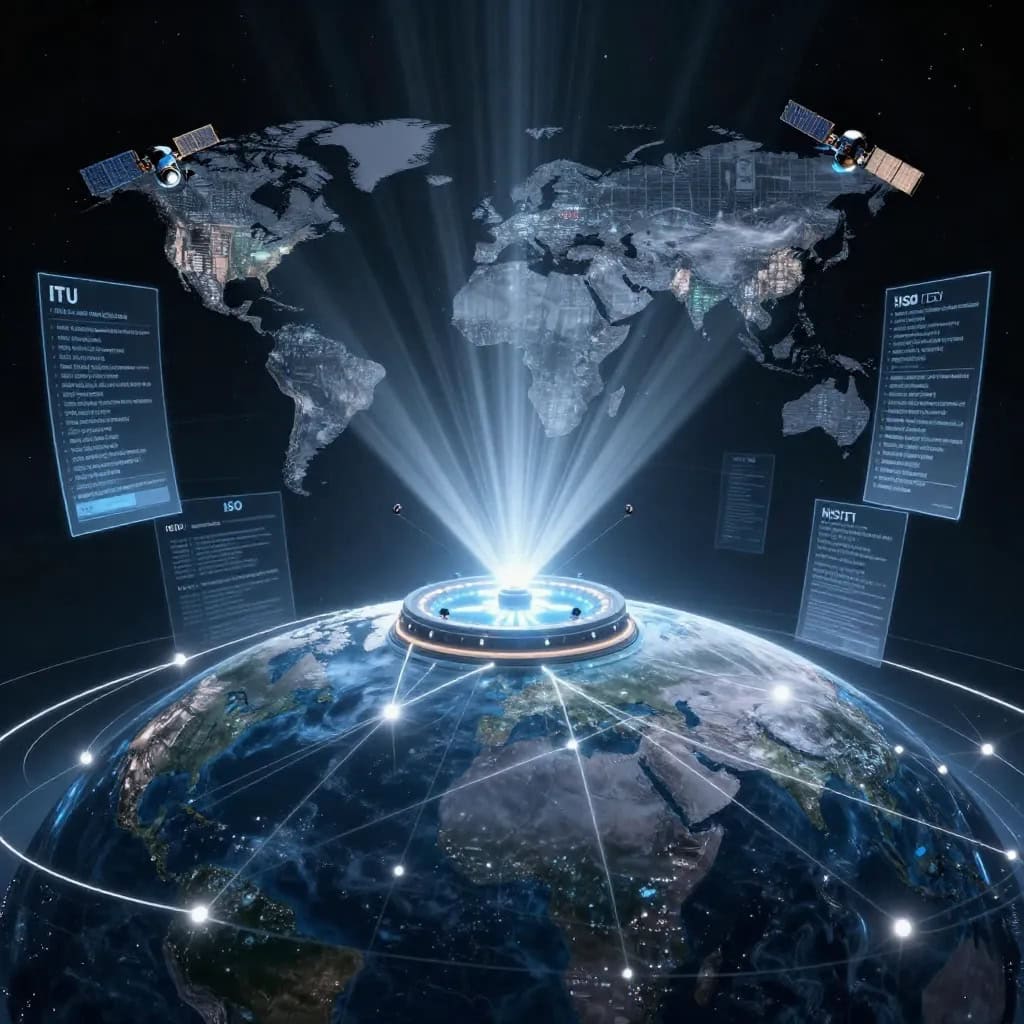
The International Telecommunication Union (ITU)
Founded in 1865, the ITU stands as one of the oldest international organizations. The United Nations agency specializes in information and communication technologies. Within its mandate, the ITU manages radio-frequency spectrum allocation and develops technical standards for telecommunications. Timekeeping features prominently in these responsibilities.
The ITU-R Study Group 7 handles time signal emissions and the coordination of standard-frequency and time-signal emissions. This group maintains standards for radiobroadcast time signals that synchronize clocks worldwide. These signals form the basis for time dissemination across continents. ITU also coordinates the use of Coordinated Universal Time (UTC) with other timekeeping authorities.
ITU's work extends to satellite-based time synchronization systems. The organization develops technical standards for Global Navigation Satellite Systems (GNSS) like GPS and Galileo. These systems distribute time signals with microsecond precision, enabling applications from financial trading to power grid synchronization.
The International Organization for Standardization (ISO)
ISO operates independently of the UN but develops voluntary international standards across numerous industries. The organization comprises national standards bodies from 163 countries. ISO/TC 154, Processes, data elements and documents in commerce, industry and administration, handles time-related standards.
ISO 8601 defines the international standard for date and time representations. This specification establishes clear formats for writing dates and times. The standard prevents ambiguity in date interpretation between different regions. For example, ISO 8601 specifies that 2023-05-15 represents May 15, 2023, rather than November 5, 2023 as might be interpreted in some locales.
ISO/IEC 15339 covers time quality and measurement aspects. This standard addresses the performance requirements for time distribution systems. It defines parameters for time accuracy, stability, and reliability. These specifications ensure timekeeping systems meet the needs of critical infrastructure.
ISO standards create a common framework for time representation and quality. This framework enables compatibility between systems developed by different organizations and in different regions. Without these standards, time-based interoperability would face significant challenges.
The National Institute of Standards and Technology (NIST)
NIST operates as a non-regulatory federal agency within the U.S. Department of Commerce. The institute develops measurement standards, promotes U.S. innovation, and industrial competitiveness. NIST maintains the nation's primary time and frequency standards.
NIST operates the NIST-F1 cesium fountain atomic clock, one of the most accurate timekeepers in the world. This clock neither gains nor loses one second in 100 million years. Such precision underpins NIST's role in maintaining Coordinated Universal Time for the United States.
The institute disseminates time through multiple channels. NIST radio station WWVB broadcasts time signals across North America at 60 kHz. The NIST Internet Time Service provides time synchronization over the network. These services synchronize everything from computer networks to wall clocks.
NIST also develops the Time and Frequency Division, which researches next-generation timekeeping technologies. This work includes optical atomic clocks, which promise even greater accuracy than current cesium-based standards. NIST innovations often become global standards through international collaboration.
Interoperability Between Standards Bodies
These organizations maintain distinct but interconnected roles. ITU ensures time signals propagate effectively across communication networks. ISO provides standardized formats for representing time. NIST develops and maintains the physical time standards.
Coordination happens through formal and informal channels. The Consultative Committee for Space Data Systems facilitates cooperation between ITU, ISO, and NIST. This committee ensures space-based time systems meet all relevant standards. The General Conference on Weights and Measures provides international consensus on time definitions.
These collaborative efforts create a coherent global timekeeping ecosystem. Each organization contributes specialized knowledge while respecting the mandates of others. This cooperation prevents conflicts between standards and ensures time accuracy across different domains.
Conclusion
Civil timekeeping relies on a complex infrastructure maintained by dedicated organizations. The ITU ensures time signals reach their destinations. ISO creates consistent representations of time. NIST develops the underlying measurement technologies. Together, these organizations enable the precise timekeeping that powers modern society.
From financial markets to power grids, transportation systems to communication networks, precise timekeeping supports countless technologies. The work of these standards bodies continues to evolve as technology advances. New challenges emerge with quantum computing, 5G networks, and space exploration. Each organization adapts to meet these challenges while maintaining the stability of timekeeping systems.
The next time you check your smartphone for the time or board a flight on schedule, consider the global infrastructure working behind the scenes. The coordinated efforts of these organizations ensure time remains a reliable foundation for our increasingly connected world.